
Library of EDA Utilities
Contact: help@edautils.ai
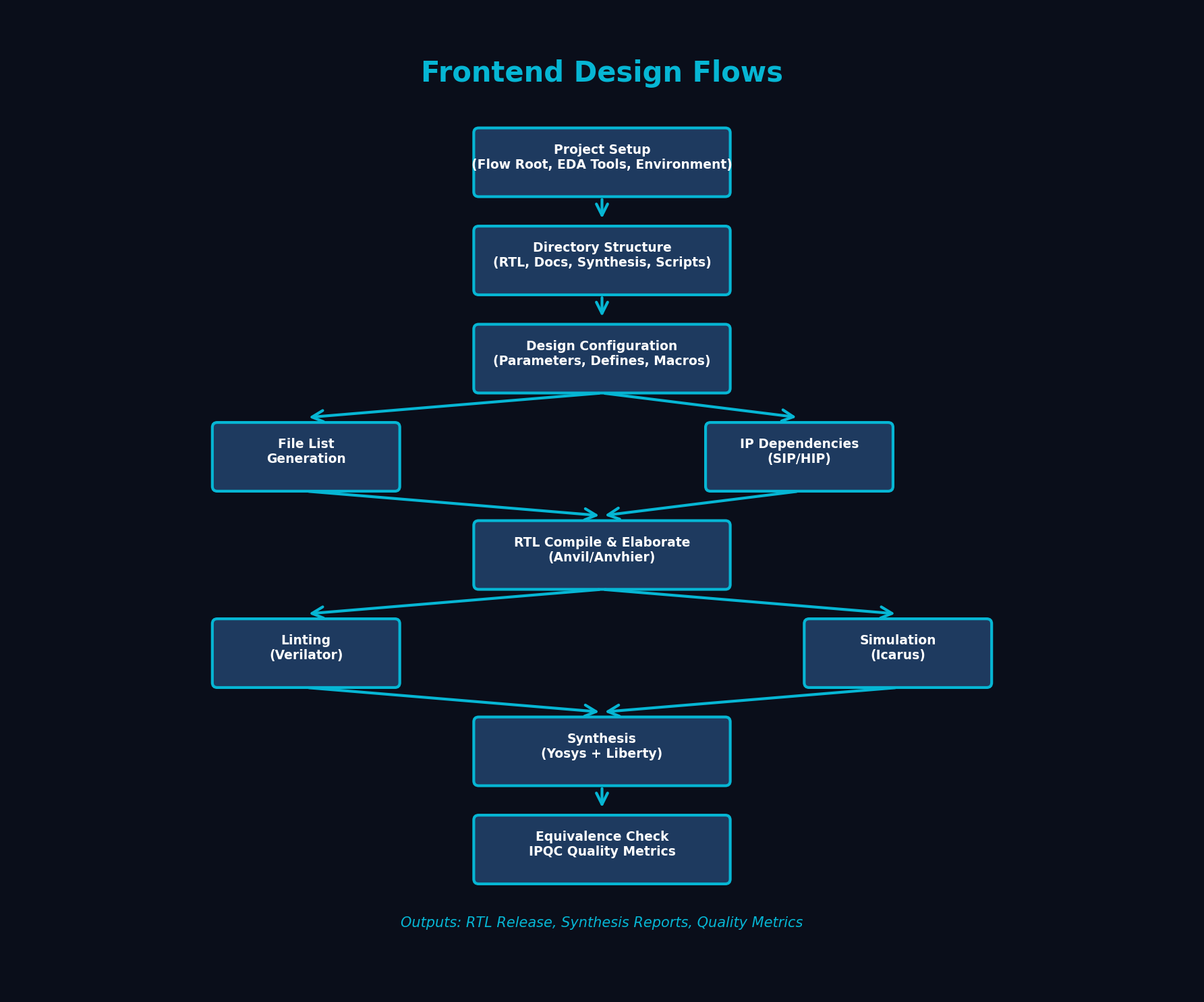
The Frontend Design Flow provides a comprehensive methodology for RTL development, from project setup through synthesis and quality checks. This flow follows industry best practices and integrates seamlessly with the EDAUtils AI System.
Flow Root Configuration: Establish FLOW_ROOT environment variable pointing to project base directory. Set EDA tool versions and licensing.
Environment Variables: Configure PATH, LD_LIBRARY_PATH, and tool-specific variables (VCS_HOME, YOSYS_PATH, etc.).
Workspace Initialization: Create standard directory tree, set permissions, initialize version control.
Generic RTL with Parameters: Write parameterizable RTL code using `parameter` and `define` macros. Example: addr_width=128, data_width=64.
Configuration Files: Maintain separate configuration files for different design variants. Use +define+ compiler directives for conditional compilation.
Parameter Overrides: Command-line parameter passing for quick design exploration. Design-time vs. compile-time parameters.
Anvil/Anvhier Tools: Fast RTL compilation and elaboration. Syntax checking, module hierarchy analysis, parameter propagation validation.
Error Detection: Catch syntax errors, undefined modules, port mismatches, width mismatches early in the flow.
Elaboration Reports: Module hierarchy tree, instance counts, parameter values, memory usage estimates.
Style Checking: Coding style violations, naming conventions, unused signals and variables.
Quality Checks: Combinational loops, inferred latches, multi-driven nets, clock domain issues.
Waiver Management: Systematic waiver of known false positives. Waiver review and audit trails.
RTL Synthesis: Yosys open-source synthesis engine. Technology mapping to ASIC or FPGA targets.
Liberty Library: Timing library (.lib) integration. Cell characterization and delay models.
Constraints: SDC (Synopsys Design Constraints) for timing. Clock definitions, input/output delays, false paths.
Reports: Area, timing, power analysis. Quality of results (QoR) metrics.
Formal Verification: Equivalence checking between RTL and synthesized netlist. Verification of design transformations.
IPQC Quality Checks: IP Quality Check automated analysis. Coverage metrics, lint clean status, synthesis QoR.
Release Criteria: Pass/fail criteria for RTL release. Quality gates and sign-off requirements.
Contact us for detailed implementation guides and support